“Subpoenas.” What Ron Wyden Could Investigate Next—and the Kash Patel Question
The Democrats’ new congressional majorities could open investigations into taxes, the Justice Department and FBI leadership. Could scrutiny of Kash Patel progress from subpoenas to impeachment? Here is what the evidence and Constitution actually permit.
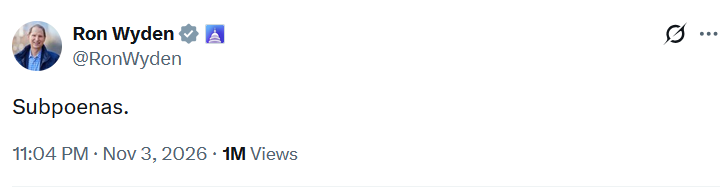
At 11:04 p.m. on election night, Senator Ron Wyden of Oregon posted a single word: “Subpoenas.” There was no accompanying list of witnesses or agencies, no committee schedule and no detailed threat. The brevity was the point. With Democrats projected by the Associated Press to control both houses of Congress after the November 3, 2026 midterms, the message suggested how one part of Washington's political machinery could change when the new Congress convenes in January.
A congressional majority does not acquire the presidency, control of federal prosecutors or the power to announce that someone is guilty. It does acquire committee gavels, staff resources, hearing agendas and, under applicable rules, authority to compel documents and testimony. The distinction matters. It is the difference between asking the executive branch to explain itself and initiating an investigation with legal consequences for refusing a valid demand.
What exactly might Wyden be planning? His public record offers clues. So do investigations already initiated by Democrats against the Trump administration, particularly questions about tax enforcement, government contracts, the independence of the Justice Department and the conduct of FBI Director Kash Patel. None of that establishes that Wyden has announced a Patel impeachment effort. It does identify possible routes for oversight—and an unusually consequential set of questions for Congress to ask.
What changes when the committees change hands?
Republicans and Democrats alike have used congressional investigations as instruments of legislative oversight and political conflict. The new Democratic majorities will be able to schedule hearings, summon agency leaders, request internal communications and use authorized subpoenas when voluntary requests fail. Committee jurisdictions will shape the assignments: the Senate Finance Committee, which Wyden is positioned to chair, oversees taxation, Treasury-related questions and major health programs; the Judiciary committees are more directly situated to examine the FBI and Justice Department.
That means Wyden need not personally lead an inquiry into every subject signaled by his post. He could investigate matters in Finance's jurisdiction, coordinate with other committees and refer evidence to colleagues. House Oversight and Judiciary leaders have separately discussed investigations of the administration, public spending, possible conflicts of interest and federal law enforcement. The Wall Street Journal reported that multiple incoming committee leaders were preparing substantial oversight programs.
One crucial limitation is timing: the election results change who will control the next Congress. They do not, by themselves, transfer committee subpoena authority on election night. Formal action depends on the incoming chamber, its committees and their rules.
Wyden's existing paper trail points toward the IRS
The most concrete clue to Wyden's own agenda may be his work on the Senate Finance Committee. In July 2026, Wyden joined other Senate Democrats in requesting an independent investigation into reports of political interference in Internal Revenue Service audits. The senators cited concerns about whether administration officials had tried to influence the agency's treatment of particular taxpayers. The letter described allegations requiring investigation, not proven violations.
In September, Wyden and Senator Raphael Warnock questioned reports that officials were considering scrutiny of the tax-exempt status of politically disfavored nonprofits. Their central question was straightforward: are tax laws being enforced according to neutral criteria, or is political disagreement affecting how the government selects targets? Committee authority could enable investigators to request decision memoranda, correspondence, agency policies and sworn testimony about how particular enforcement decisions were reached.
Wyden has also identified tax evasion, health insurers, banks and pharmaceutical companies as potential areas for scrutiny, according to post-election reporting. Those subjects fit Finance's remit more directly than management of the FBI. They suggest that the word “Subpoenas” may encompass a large amount of economic and administrative oversight, not only high-profile confrontations with Trump officials.
The Kash Patel question: an existing investigation could expand
FBI Director Kash Patel is a different but plausible focus of the incoming Congress's wider oversight agenda. The relevant documented starting point is a July 9, 2026 inquiry launched by House Judiciary Democrat Jamie Raskin and Senate Judiciary Democrat Dick Durbin. Their announcement raised concerns about taxpayer-funded travel, official aircraft and other resources used by the FBI director, citing additional correspondence involving Republican Senator Chuck Grassley. These were allegations and requests for information, not judicial findings that Patel had committed a crime.
A majority-led investigation could demand travel authorizations, flight manifests, reimbursement records, policies defining official and personal use, security justifications, inspector-general assessments and the communications through which exceptions were approved. Investigators would also need to distinguish legitimate security requirements from personal expenditures and consider the director's explanations. A record of unusually expensive travel alone would not establish intentional misuse or an impeachable offense.
Congress could separately scrutinize whether FBI staffing, investigative priorities and personnel decisions were made for legitimate law-enforcement reasons. Members have raised concerns about the Bureau's direction; Patel, in his September 2025 House testimony, defended redirecting resources toward cartels, violent crime, terrorism and other threats, describing a responsibility to steward public funds. A serious hearing would test specific decisions against contemporaneous documents and operational outcomes, rather than treating either the criticism or Patel's defense as dispositive.
Could Congress investigate Patel for “high crimes and misdemeanors”?
Yes, Congress can investigate facts that might support an impeachment inquiry into a federal civil officer. But “high crimes and misdemeanors” is a constitutional standard, not a criminal conviction already attached to Patel. Whether any conduct satisfies it would require a developed evidentiary record and a political-constitutional judgment by the chambers of Congress.
For Patel, one possible investigative question would be whether there was deliberate abuse of official power, obstruction of lawful oversight, corruption, or serious violation of public trust. Another would be whether any alleged misconduct was supported by documents, credible witnesses and an opportunity to respond. These are hypothetical areas of inquiry, not findings that Patel committed any such acts.
Congress could receive whistleblower accounts, compare sworn testimony with agency records and require explanations for potential inconsistencies. But allegations must be tested. Members should distinguish policy disagreements, management failures, ethics violations, statutory crimes and conduct that might meet the separate impeachment standard. The Constitution does not make every controversial executive decision impeachable.
How removal of an FBI director through impeachment would actually work
Wyden cannot remove Patel with a Senate committee hearing or a subpoena. Under the Constitution, the House of Representatives has the sole power to impeach. The House would need to investigate, formulate articles of impeachment and approve them by a simple majority. That vote is an accusation—not a conviction or removal.
The Senate then tries the impeachment. Conviction requires agreement from two-thirds of senators present, after which the official is removed. A separate vote may disqualify the person from future federal office. As the Senate's own impeachment history explains, the category of “high crimes and misdemeanors” has never had a single exhaustive definition. Evidence, constitutional precedent and the judgment of senators therefore matter.
For that reason, Democratic control of the Senate alone would not guarantee Patel's removal through impeachment; even a substantial majority could fall short of the two-thirds threshold. Meanwhile, a president can ordinarily remove an FBI director through the executive branch's separate appointment-and-removal framework. Congressional oversight, political pressure, resignation, presidential removal and impeachment are distinct mechanisms that should not be conflated.
What an evidence-based Patel investigation would need to show
Consider the difference between three possible findings. First, investigators might conclude that some travel expenses violated internal guidelines but involved no deception or corrupt purpose; that could prompt reimbursement, administrative reform or a referral for further review. Second, investigators might identify conflicting explanations, missing records or apparent interference with inspectors general; that could justify more subpoenas and sworn testimony. Third, they might uncover evidence of knowing abuses of power sufficiently grave for House members to debate impeachment articles. None of these outcomes should be announced before the supporting evidence is established.
Past inquiries into Patel also require careful handling. Reuters reported in March 2026 that investigators working for former special counsel Jack Smith had obtained records relating to Patel's communications while he was a private citizen. Reuters explicitly said it could not determine what allegations, if any, were being investigated regarding Patel. Those subpoenas do not themselves prove wrongdoing, and they concerned a different period than his current FBI leadership.
Subpoena power has constitutional limits
Congressional subpoenas carry legal force, but they are neither search warrants nor declarations of guilt. Requests must serve a legitimate legislative purpose, fall within lawful committee authority and respect relevant constitutional rights. Recipients may negotiate scope, challenge demands or raise legal privileges. The executive branch may resist production on executive-privilege grounds, sometimes leading to prolonged litigation.
A subpoena's practical force also depends on enforcement. Congress can pursue contempt processes and civil remedies, but those routes can be slow, especially when a dispute pits congressional investigators against the executive branch. The Congressional Research Service describes the enforcement difficulties, including reliance in some cases on the Justice Department to pursue criminal contempt referrals. The outcome is not automatic merely because a committee voted to issue a demand.
There is a notable irony in Wyden's one-word post. Earlier in 2026, he helped introduce bipartisan legislation intended to curb government misuse of subpoenas for Americans' phone records. He also pressed for scrutiny of secrecy demands used in surveillance matters. That history suggests the importance of separating congressional oversight directed at public accountability from expansive government demands that intrude on the privacy or associational rights of ordinary people. His May 2026 proposal explicitly called for stronger safeguards.
What else could be on the subpoena calendar?
Other Democratic committee leaders have identified possible investigations involving presidential business interests, contractors, immigration enforcement, the Justice Department, and records related to Jeffrey Epstein. Some disputes concern money and procurement; others involve questions of agency independence, official decision-making or information the government has not disclosed. The specific scope of each inquiry will matter more than the rhetoric surrounding its announcement.
Oversight can also produce legislation without an impeachment trial. Hearings could lead to proposals for tighter financial-disclosure rules, protections against politically directed tax enforcement, reforms to inspector-general access, limits on government surveillance or clearer requirements for agency travel expenses. Those are legislative outcomes within Congress's traditional role, although enactment would still require navigating the Senate and presidential veto powers.
The questions that will determine whether “Subpoenas” changes anything
By January, the significant questions should be measurable. Which committees publish investigative mandates? What documents are requested, and what is produced? Are witnesses interviewed under oath? Do independent records corroborate the accusations? Are targets allowed to respond? Do committees release evidence relevant to their conclusions, with appropriate protection for privacy, national security and ongoing investigations?
The Patel question is a particularly useful test. A documented inquiry already exists. A new majority could deepen it; it could also find explanations that weaken initial suspicions. Investigating possible misconduct is not the same as determining guilt, and removing a federal officer through impeachment remains a far more demanding constitutional act than issuing a subpoena.
Wyden's post was only one word. The next Congress will decide whether that word produces new evidence, new legislation, an impeachment debate or simply another protracted fight over access to records. The public deserves to see the documents and reasoning that distinguish those outcomes—not just the headlines.